
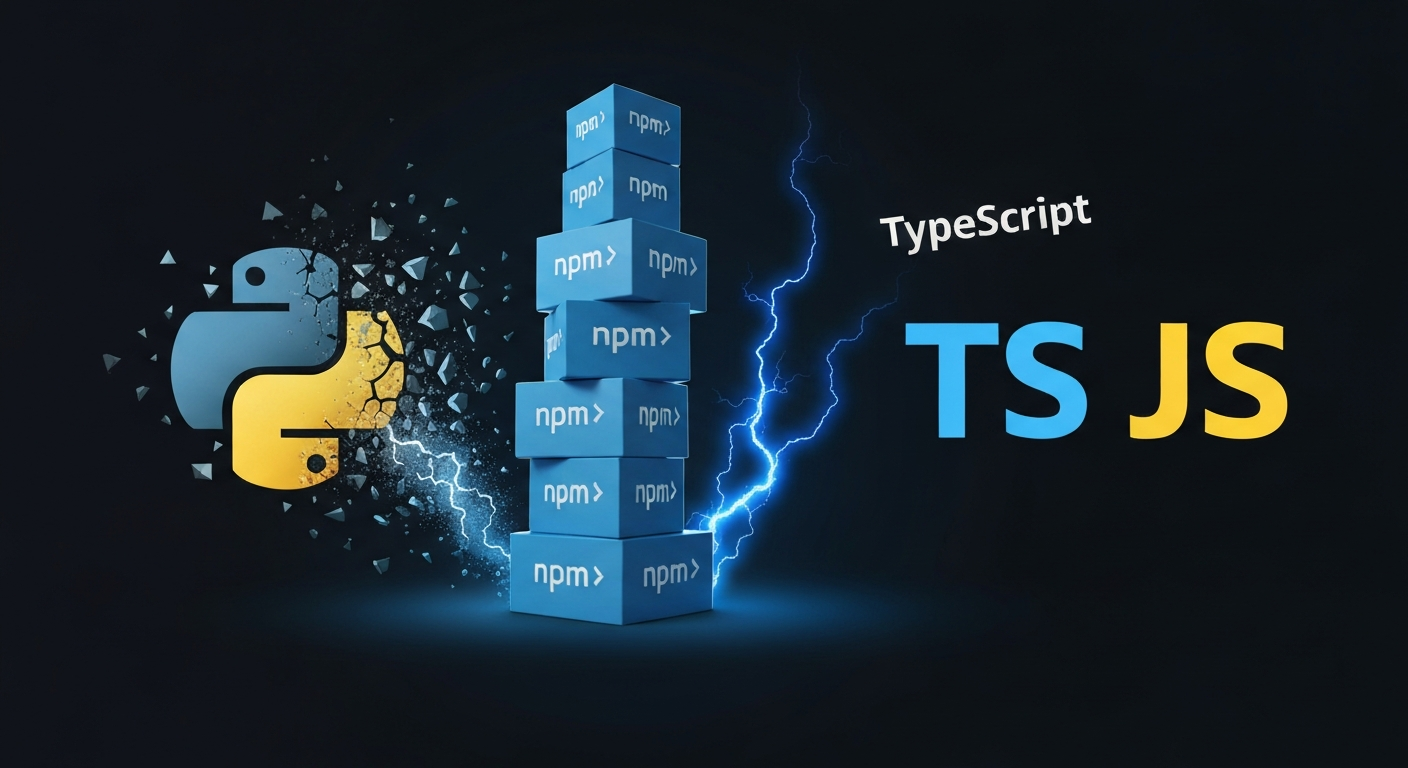
This is not a prediction. It is a trajectory.
In August 2025, TypeScript surpassed Python on GitHub with over 2.6 million contributors. GitHub called it the most significant language shift in more than a decade. By 2026, 78% of professional developers use TypeScript, up from 69% just two years earlier. 40% write exclusively in TypeScript. Only 6% still write plain JavaScript.
Python is not dying overnight. But the ground underneath it is eroding, and the reason has less to do with the language itself and everything to do with the ecosystem around it.
The Package Manager Is the Platform#
Here is the thing most people miss: a programming language is only as strong as its package ecosystem. And the package ecosystem is only as strong as its package manager.
npm has over 2 million packages. It is the largest software registry in the world. When you run npm install, you get deterministic dependency resolution, lockfiles, semantic versioning, local project isolation, and a global registry that every JavaScript developer on the planet shares. It is not perfect, but it set the standard.
Now look at Python. pip installs packages globally by default. You need virtual environments just to avoid breaking your system. There is no built-in lockfile. Dependency resolution has been a known problem for years. And the tooling is fragmented across pip, virtualenv, pip-tools, pipenv, Poetry, conda, and now uv and Rye.
Python has spent a decade trying to solve what npm solved out of the box. uv, the new Rust-based package manager from Astral, is 10 to 100 times faster than pip. That is impressive. But it is also an admission that the existing tooling was fundamentally broken. You do not build a ground-up replacement for something that works.
One Language, Every Surface#
JavaScript started in the browser. Then Node.js brought it to the server. Now it runs everywhere.
Deno gives you a secure runtime with TypeScript support built in. Bun gives you speed and a unified toolchain. Edge runtimes from Vercel and Cloudflare run JavaScript at the network edge with cold starts under 5 milliseconds. WebAssembly extends the reach to IoT devices and embedded systems, executing at 80 to 95% of native speed.
With TypeScript, you write one language and it runs on the client, the server, the edge, the database layer, and the build system. The T3 stack, Next.js plus tRPC plus Prisma plus Tailwind, shares types from your database schema all the way to your React components. No manual type annotations in the happy path. No context switching between languages.
Python runs on servers. It runs in notebooks. It does not run in browsers. It does not run at the edge. It does not run on the client. Every Python project that needs a frontend is already writing JavaScript or TypeScript for half the application. That is not a full-stack language. That is a backend language pretending to be universal.
AI Was Supposed to Save Python#
The counterargument is always AI. Python leads in machine learning, data science, and AI research. Jupyter Notebook usage nearly doubled in 2025. AI-related Python projects grew 98% year over year.
But look closer. The AI frameworks are already shipping JavaScript SDKs. Vercel's AI SDK, LangChain.js, Hugging Face's Transformers.js, and TensorFlow.js all exist and are production-ready. The inference layer is moving to APIs, and APIs do not care what language calls them.
The training and research side of AI will stay in Python for a while. But that is a shrinking percentage of what developers actually build. Most engineers are not training models. They are calling them. And for that, TypeScript is already the better choice because it gives you type safety across your entire application stack.
The npm Model Is the Future Standard#
npm proved something fundamental: a centralized, well-tooled package registry becomes the connective tissue of an entire developer ecosystem. It is how code gets shared, discovered, versioned, and composed. Every modern JavaScript framework, every utility library, every CLI tool lives in npm. The registry is the platform.
PyPI exists. But it never achieved the same gravity. The fragmented tooling means there is no single source of truth for how Python projects declare, resolve, and share dependencies. uv and Rye are trying to fix this, but they are building toward a model that npm established years ago.
The lesson is clear: the language that wins is the one with the best ecosystem for sharing code. npm set that standard. TypeScript adopted it wholesale. Python is still catching up.
The Timeline#
Python will not vanish next year. But here is what the next five years look like:
-
TypeScript becomes the default for all new web projects. This has already happened. 83% of new projects use TypeScript.
-
AI application development shifts to TypeScript. The model APIs are language-agnostic. The application layer around them benefits from type safety, and TypeScript provides it end to end.
-
Python retreats to research and data science. The same way Fortran retreated to scientific computing. Still used. Still respected. But no longer the language people reach for first.
-
The Python package ecosystem consolidates or fragments further. If uv succeeds in becoming the universal Python package manager, Python survives longer. If the community stays fragmented, the erosion accelerates.
-
Full-stack TypeScript becomes the default for startups, enterprises, and solo developers. One language, one type system, one package manager, every surface.
The writing is on the wall. TypeScript surpassed Python on GitHub. npm is the largest software registry in the world. JavaScript runs on every computing surface that exists. Python's fragmented tooling is playing catch-up to standards that npm defined a decade ago.
The question is not whether Python will lose ground. It is how fast.
Comments (0)
Sign in to join the conversation