
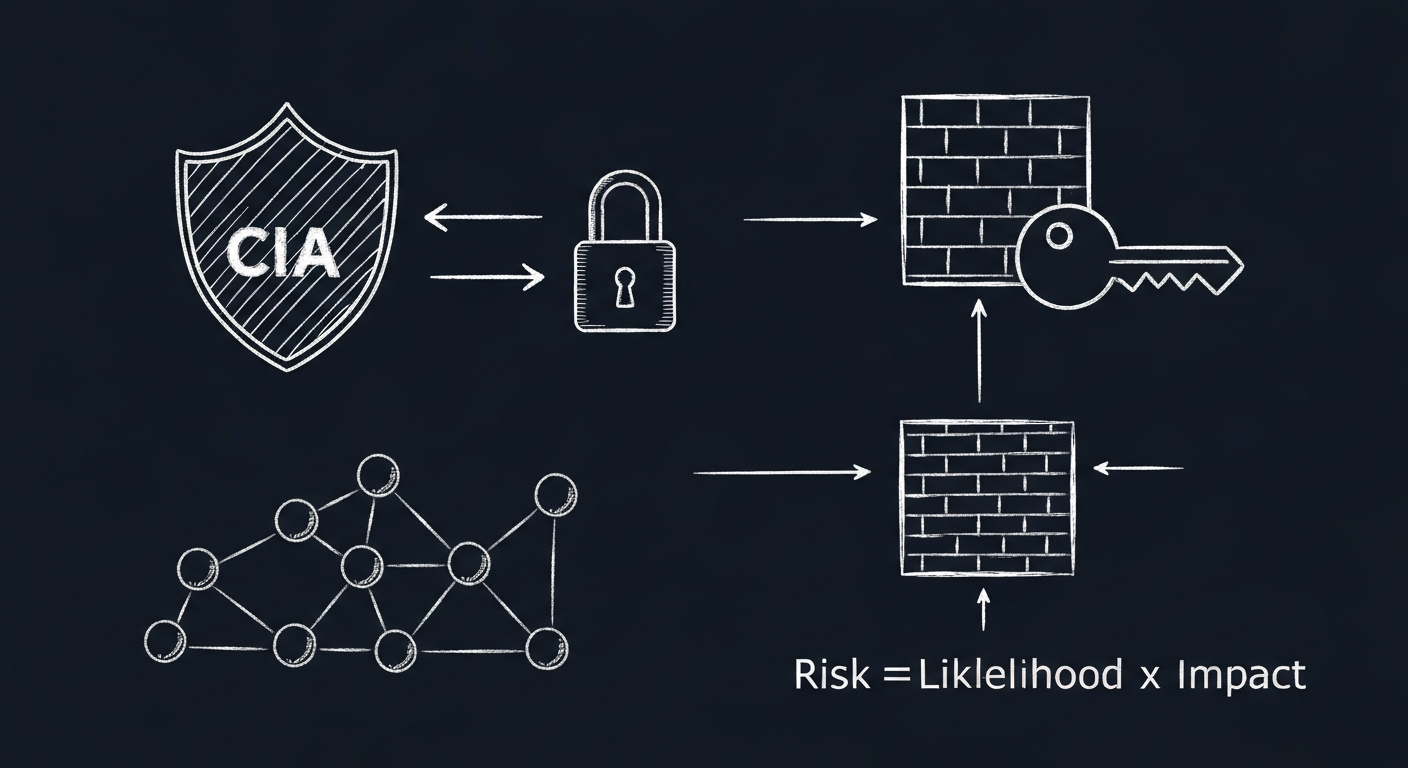
What Is Network Security?#
If you're building anything that touches a network, you need to understand how to protect it. Network security is the set of technologies, processes, and policies that keep networked systems safe. That includes your cloud infrastructure, your APIs, your databases, and everything in between.
The goals are simple:
- Keep data safe from people who shouldn't have it
- Make sure nobody tampers with it
- Keep systems running when they need to run
- Control who gets access to what
- Catch problems before they become disasters
If you're deploying to AWS, running Kubernetes, or building microservices, this isn't optional knowledge. It's the baseline.
The CIA Triad#
Every security decision you'll ever make comes back to three things: Confidentiality, Integrity, and Availability. The CIA triad.
Confidentiality#
Can the wrong people see your data? If yes, you have a confidentiality problem.
This covers everything from encrypting data at rest to making sure your .env file isn't committed to GitHub. It also includes privacy regulations like GDPR and CCPA that dictate how personal data gets collected and stored.
The tools: encryption, access control lists, VPNs, multi-factor authentication.
Integrity#
Has someone messed with your data? Can you prove they haven't?
Data integrity means the information hasn't been altered in transit or at rest by someone who shouldn't have touched it. System integrity means your servers are doing what they're supposed to do without rootkits or unauthorized firmware changes running underneath.
The tools: hashing algorithms like SHA-256, digital signatures, file integrity monitoring.
Availability#
Can your users actually reach your service?
This is about uptime. It's about making sure a DDoS attack doesn't take you offline, a hardware failure doesn't lose your data, and a cloud region outage doesn't kill your entire product.
The tools: redundancy, failover clusters, load balancers, disaster recovery plans.
A data breach is a confidentiality failure. A man-in-the-middle attack altering your API responses is an integrity failure. A DDoS attack bringing down your production servers is an availability failure.
Authentication, Accountability, and Non-Repudiation#
The CIA triad gets all the attention, but there are three more concepts that matter just as much in practice.
Authentication#
How do you know someone is who they claim to be?
For users: MFA, biometrics, certificates. For messages: HMAC, digital signatures. For devices: device certificates, TPM attestation.
Getting authentication wrong is how breaches happen. It's the front door to everything.
Accountability#
If something goes wrong, can you figure out who did it?
This is where audit logging and SIEM systems come in. You need to know who did what, when, and from where. Not just for incident response but also as a deterrent. People behave differently when they know their actions are tracked.
Non-Repudiation#
Can someone deny they did something?
Digital signatures solve this. If you sign a document or a message with your private key, you can't later claim you didn't send it. It's the cryptographic equivalent of a handwritten signature, except it actually works.
Core Security Concepts#
Threat, Vulnerability, Exploit#
These three words get thrown around interchangeably, but they mean very different things. Think of it like a house:
- A vulnerability is an unlocked window. It's a weakness that exists whether or not anyone knows about it. Unpatched software, a default password left in production, an open S3 bucket.
- A threat is the burglar walking down your street. It's anything that could exploit a weakness. An APT group, a disgruntled employee, even a misconfigured cron job that accidentally deletes your database.
- An exploit is the burglar climbing through that unlocked window. It's the actual mechanism used to turn a vulnerability into damage. A SQL injection payload, a buffer overflow, a phishing email with a malicious link.
A vulnerability without a threat is just technical debt. A threat without a vulnerability has no way in. An exploit is what happens when both line up.
Risk#
Risk = Likelihood x Impact
You can't eliminate risk. You manage it. Four ways:
- Mitigate means reduce the risk directly. Patch the vulnerability, add a WAF, enforce MFA. This is the default move for anything critical.
- Accept means acknowledge it and move on. If fixing a low-severity issue costs more than the potential damage, sometimes the right call is to document it and accept the residual risk.
- Transfer means make it someone else's problem. Cyber insurance, SLAs with your cloud provider, or outsourcing PCI compliance to a payment processor like Stripe.
- Avoid means stop doing the thing that creates the risk. If storing credit card numbers creates too much liability, don't store them at all.
Security is not about being invulnerable. It's about making informed trade-offs between cost, usability, and exposure.
Why This Matters If You're a Developer#
I work with Spring Boot, React, Next.js, and cloud-native architectures. These security concepts aren't abstract theory for me. They show up in real code decisions every day:
- Confidentiality when I encrypt JWT tokens, enforce HTTPS, and manage environment variables properly
- Integrity when I sign API requests, maintain database transaction integrity, and use Git commit signing
- Availability when I configure Kubernetes health checks, set up load balancing, and build graceful degradation into services
- Authentication when I implement OAuth 2.0 flows, integrate Google Sign-In, and build role-based access control
Security isn't a separate discipline. If you're writing code that handles real user data, you're already doing security work. The question is whether you're doing it intentionally or accidentally.
Key Takeaways#
- The CIA Triad is the foundation. Every security decision maps back to confidentiality, integrity, or availability
- Authentication verifies identity. Authorization grants permissions. They're not the same thing
- Non-repudiation prevents people from denying their actions. Digital signatures are how you enforce it
- Risk management is about trade-offs, not perfection. You choose which risks to mitigate, accept, transfer, or avoid
- Think about security from day one. Bolting it on after the fact is always harder and more expensive
Comments (0)
Sign in to join the conversation