
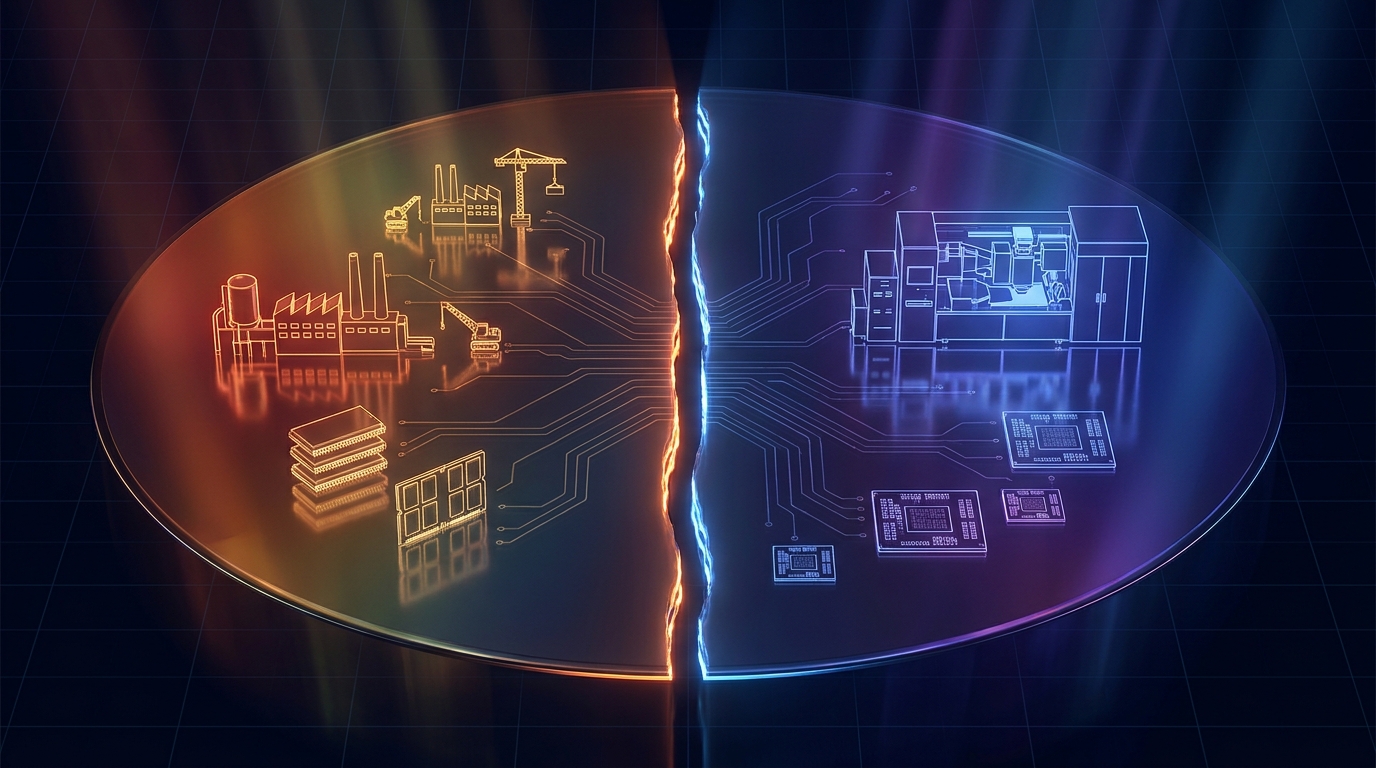
People mix up the chip companies all the time. I have heard "China needs TSMC to make its memory chips" and "ASML makes chips" in the same conversation. Neither is true, and once you sort out who does what, the bigger story about China's push for self-sufficiency becomes much easier to follow. So here is the map, the way I explain it to friends.
First, the vocabulary#
A handful of names come up constantly, and they do very different jobs.
| Term or company | What it actually is |
|---|---|
| DRAM | Working memory, the RAM in your laptop or server. Fast, and it forgets everything when the power goes off. |
| NAND | Permanent flash storage. This is what sits inside SSDs and phones. |
| CXMT | A major Chinese DRAM producer, based in Hefei. |
| YMTC | A major Chinese NAND producer, based in Wuhan. |
| TSMC | A foundry. It manufactures chips designed by other companies such as Nvidia, Apple and AMD. It does not design those chips itself. |
| ASML | Makes lithography machines, the tools a fab uses to print patterns onto wafers. It does not make chips or wafers. |
The key point: CXMT and YMTC operate their own fabs. They design and manufacture their memory in house, so they do not need TSMC at all. What they have needed is equipment, and a lot of that equipment historically came from abroad: ASML, Nikon and Canon for lithography, Applied Materials, Lam Research and Tokyo Electron for etch and deposition, KLA for inspection.
That equipment dependence is exactly where the pressure is, and exactly where China is spending.
The whole chain, from sand to server#
A chip is not one product. It is the output of a long chain, and each link is its own industry with its own leaders.
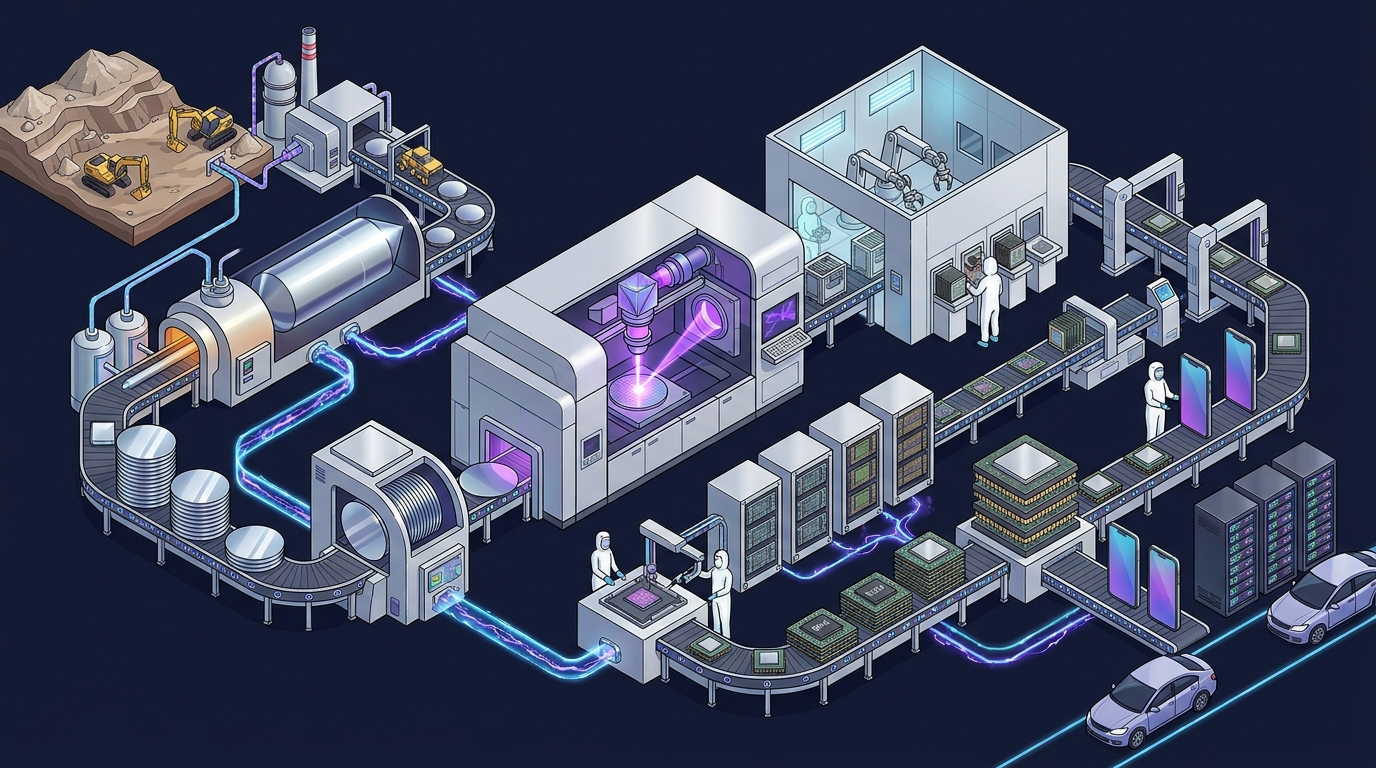
- Raw materials. Polysilicon, specialty gases, photoresist, and inputs like gallium and germanium.
- Wafers. The polished 300 mm silicon discs every fab starts from.
- Chip design and EDA. Architectures and IP blocks, plus the design software (EDA) without which you cannot lay out a modern chip.
- Manufacturing equipment. Lithography, etch, deposition, inspection, metrology.
- Fabs. The factories that pattern the wafers. Foundries like TSMC and SMIC, or integrated makers like Samsung, CXMT and YMTC.
- Memory and logic chips. DRAM, NAND, HBM, CPUs, GPUs, AI accelerators.
- Packaging and test. Cutting the wafer, stacking dies, wiring them up, testing them.
- Finished devices. Phones, servers, cars, AI systems.
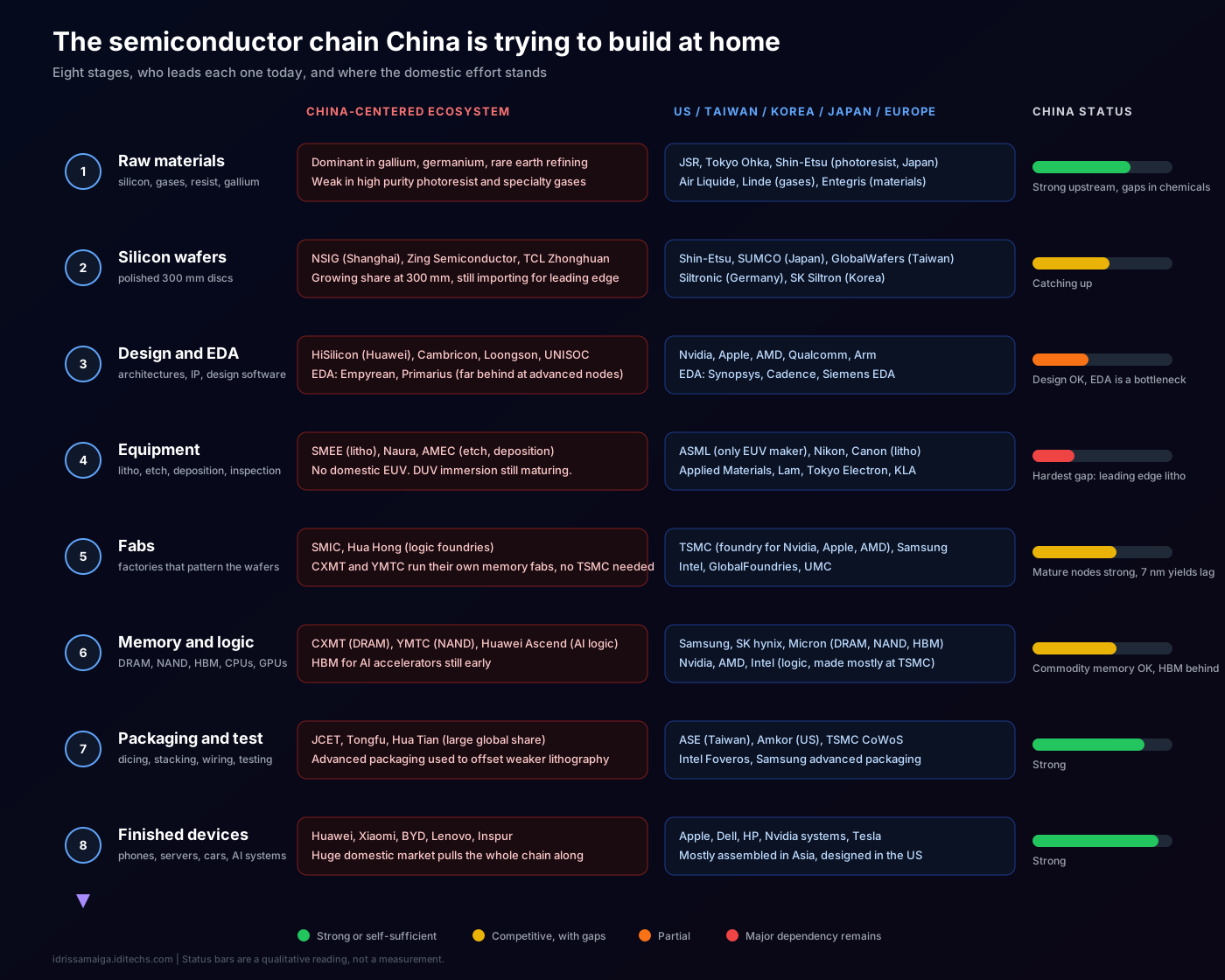
Here is how I read the state of each stage today, with the main players on each side.
What China is actually trying to do#
The strategic goal is not to win one segment. It is to own every link, so that no export control at any single stage can stop the line. That means reducing dependence on ASML for lithography, on TSMC for leading edge logic, on Nvidia for AI accelerators, on Synopsys and Cadence for design tools, and on Japanese suppliers for materials.
The method is familiar. A huge domestic market guarantees demand. State funding arrives at the scale of national infrastructure. And policy pushes Chinese fabs to qualify Chinese tools even when those tools are a generation behind. Naura and AMEC in etch and deposition, SMEE in lithography, Empyrean and Primarius in EDA are all being pulled forward by that demand, whether or not they are the best option on the market today.
Where it has worked#
Progress has been real, and I think people outside the industry underestimate it.
- Memory. CXMT ships DRAM that competes on price in the mainstream market, and YMTC's NAND has been technically competitive for years. Both run their own fabs.
- Mature nodes. SMIC and Hua Hong produce enormous volumes at 28 nm and above, which is where most of the world's chips actually live: cars, appliances, power electronics, industrial control.
- Advanced logic without EUV. SMIC has produced 7 nm class chips for Huawei using multi patterning on older DUV machines. Yields and cost are worse than TSMC's, but the chips exist, which plenty of people said was impossible.
- Packaging. JCET, Tongfu and Hua Tian already hold a large share of the global market, and advanced packaging is being used to partly compensate for weaker lithography.
- Upstream materials. China dominates the refining of gallium, germanium and rare earths, which gives it leverage of its own in the other direction.
Where it is stuck#
The gaps are just as real.
- Leading edge lithography. ASML is the only company on Earth that makes EUV machines, and China cannot buy them. Domestic DUV immersion tools are still maturing. Without EUV, every node below 7 nm costs more and yields less.
- Yields. Producing a chip and producing it economically are two different things. Multi patterning on DUV burns wafers, time and money.
- HBM. The stacked high bandwidth memory that AI accelerators depend on is dominated by SK hynix, Samsung and Micron. Chinese HBM is early.
- EDA. Designing a chip at an advanced node without Synopsys or Cadence is not a solved problem. Domestic tools work for older nodes and for specific steps of the flow.
- The ecosystem itself. Thousands of small suppliers of parts, chemicals, software and know how form an invisible layer under the famous names. That takes decades to replicate, not years.
Two worlds, not one winner#
The story usually gets told as "will China destroy ASML, TSMC and Nvidia?" I think that is the wrong question.
The more plausible long term outcome is two increasingly independent ecosystems. One centered on China, serving its own market and a good part of the Global South with good enough chips on mature and near leading nodes. Another centered on the US, Taiwan, Korea, Japan and Europe, holding the leading edge and the most advanced AI hardware.
Both will be big. Both will keep investing. Both will be worse off than a single integrated chain, because duplication is expensive and each side loses the other's customers. But that is where the incentives point, and incentives usually win.
For anyone building products, the practical takeaway is simple: know which ecosystem your supply chain sits in, and assume the seam between the two gets wider, not narrower.
Comments (0)
Sign in to join the conversation